
🎧 Prefer audio? Here are two AI‑made podcasts of similar duration to choose from:
This version includes some background and context not included in the text:
This version is more contained:
Imagine carrying an invisible tool that never leaves your side — ancient, free, and powerful enough to ease both modern anxieties and prehistoric instincts. No one teaches you to use it, yet using it daily can reshape your life. I have relied on it for 2,085 consecutive days. Today is my birthday, and having used it again this morning, I offer this reflection as my gift to you.
Endless theory, reading science articles and stories of astounding feats by others cannot replace the most critical requirement for personal growth – implementation of protocols. Bear this in mind as you read through.
If you find it useful, please share this with your family and friends. All the other 180+ articles are here.
If you would like detailed guidance to discreetly upgrade your life – health and wealth – visit the mentoring page or the coaching conversation page.
(NEW!) For some testimonials from around the world, go here.
Contents
What is it? Is it Safe to Use?
Using it Safely
Non-Negotiable
Reasons, not Excuses
Voluntary Journey – Comfort to Trauma
Why it is Beautiful
Benefits
1234Physical Benefits
1234Focus on the Internal-External Spectrum
1234Observation of Thoughts
1234Observation of Your Body
1234Developing Control
1234Brain and Cognitive Performance
12341234Cerebral Circulation and Oxygenation
12341234Stress Regulation & Mental Performance
12341234Neuroprotection & Regeneration
1234Consistency Muscle Training
1234Deprivation for Joy
1234Mastery over the Unholy Trinity
Tracking
Take-Home Message
Parting Message
My Breath Hold – Rough Description [top]
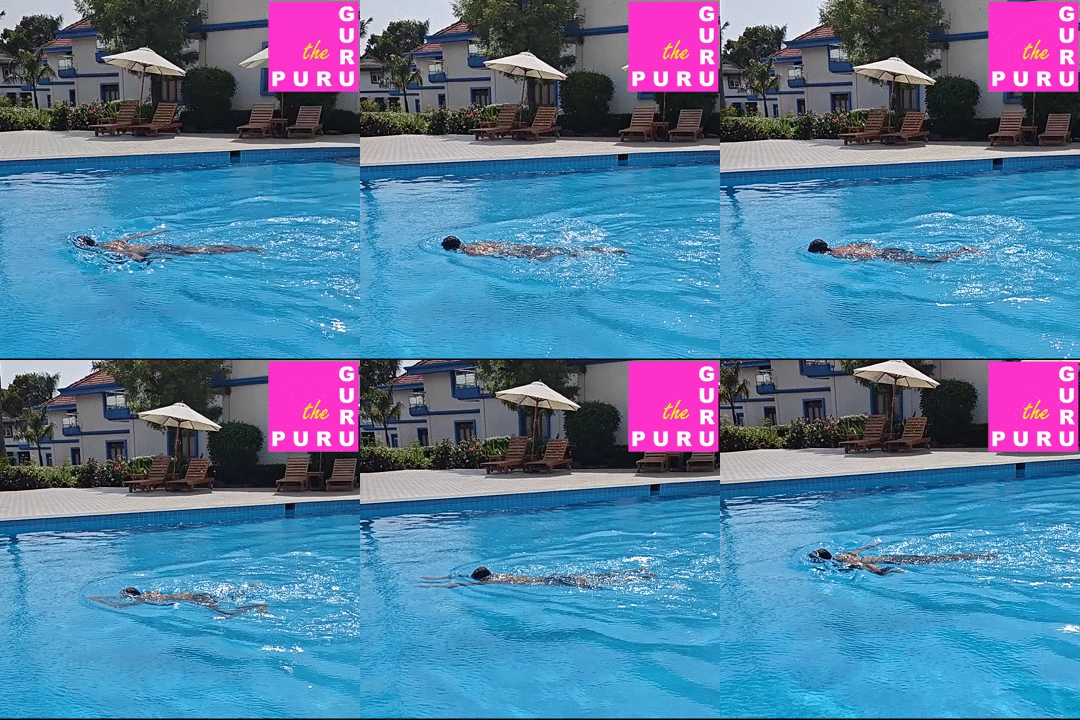
I do a breath hold every day, usually at a fixed point relative to other tasks. The duration varies depending on the many factors I describe below. Where I do my daily breath hold shifts with the phase of the year or even the day of the week. I might do it lying down, sitting, walking, climbing stairs, floating underwater, swimming underwater, or even across that invisible boundary between an aircraft accelerating on the runway and rising in the skies after takeoff.
There are several protocols that can precede my breath hold: hyperventilation, a single deep inhalation, a hold after an exhale, or simply beginning from a relaxed, neutral equilibrium.
What is it? Is it Safe to Use? [top]
A “breath hold” is precisely what those 2 words mean – you simply hold your breath. Perhaps the first few times, you might pinch your nostrils and keep your lips together to convince yourself that you are not taking a breath in, but soon you will not need your hands to do it without cheating.
At the safest end of the safe-deadly spectrum, you should perform it “dry” on land, ideally while seated or lying down, without hyperventilation before it and without competing with someone else’s number. At the deadly end, if you want to risk death with high probability, you can hyperventilate before going underwater, do it with no one else around to rescue you in an emergency, and endure past all discomfort until you blackout and drown. I will never recommend that you consciously risk death or brain damage.
Using it Safely [top]
As with any tool or weapon, you must learn to use it safely, for your benefit and without harming others. On day 1, you might hold your breath for a few seconds while being seated. Many months later, you might hold it for several minutes underwater. On all days, SAFETY FIRST should remain your motto.
Non-Negotiable [top]
Like many other things that I do, a daily breath hold is a non-negotiable. I have talked in the past about your non-negotiables, and I included a practical definition of the term. How you do one thing is how you do everything. Chasing excellence with reasonableness necessitates ensuring that non-negotiables are part of your way of life, part of your internal culture. What you choose to make a “NN” defines who you become.
Reasons, not Excuses [top]
My daily notes on the breath hold provide reasons, not excuses – a distinction we must all make for high-performance outcomes in the long run. I missed, inexcusably, doing a conscious breath hold on 3 of the last 2,085 days. All 3 days were dates on which I had broken my rhythm because of travel related to Goa – these were reasons, not excuses, because I have travelled across the world numerous times in those 2,085 days without failing to do a conscious breath hold daily. I turned 57 today, and a breath hold within seconds of waking — taken all the way to the edge of my physical tolerance — was how I welcomed another day, another year.
Voluntary Journey – Comfort to Trauma [top]
A breath hold usually begins with a feeling of ease and a sense of optimism about it. Within seconds, that ease can shift into discomfort — physical, emotional, or both. When pushed to the limit, the experience becomes traumatic in a controlled, voluntary way, stressing the body and mind together. So, then what happens spiritually? No one can say with certainty, but because it stretches us physically, mentally, and emotionally, I continue to believe that — in the realm that matters most to me — it nudges the spiritual needle a tiny bit in the correct direction every day.
Why it is Beautiful [top]
I believe that the daily breath hold I do is exquisitely beautiful. It can be done anywhere, at any time you choose. It pairs with anything else you are doing. It needs no money, no equipment, no preparation, no clearing up afterwards. It requires no one else, and no one needs to know you are doing it. Even in public, you can practice it invisibly — unnoticed, undisturbed, entirely your own.
What is most beautiful about it is that, based on the only currency you truly own, your healthy time, the investment is minuscule – the return is significant – a perfect large ROTI recipe!
Benefits [top]
Based on my 2000+ experiences, and based on what the published scientific evidence tells us, let us go through the benefits of a daily breath hold to motivate you to do something similar. Some of the benefits (e.g. emotional tolerance to discomfort) you will observe within your progress, while others (e.g. stem cell mobilization) you have to have faith will emerge because the science says it ought to.
Physical Benefits [top]
Breath‑holding is a powerful, accessible way for you to build physical resilience and optimise how your body manages oxygen. Brief periods of intermittent hypoxia stimulate your production of erythropoietin (EPO), increasing your red blood cell count and temporarily boosting your VO₂ max by up to 5%. As carbon dioxide rises, it triggers the Bohr effect, helping your haemoglobin release oxygen more efficiently to the tissues that need it most. This training strengthens your diaphragm and respiratory muscles and lowers your resting lactate levels, enhancing both your endurance and anaerobic performance.
Beyond the immediate gains, your daily practice acts as a hormetic stressor that drives deep cellular adaptation. Short, controlled hypoxic episodes encourage your stem cells to mobilize from the bone marrow, supporting tissue repair in conditions such as osteoarthritis or Parkinson’s disease. They also promote new blood‑vessel formation through VEGF (Vascular Endothelial Growth Factor), strengthening your cardiovascular health by developing natural bypasses or coronary collaterals. Additionally, breath‑hold stress induces p53 — the “guardian of your genome” — which supports your DNA repair and offers a natural defence against cancer and age‑related cellular decline.
Focus on the Internal-External Spectrum [top]
A breath hold is, without a doubt, if nothing else, a mindfulness practice. At times, it may be that you must keep your eyes open for safety and then your focus will be on the space around you. At other times, you might enjoy the benefit of keeping your eyes shut for part or all of the hold. An internal focus is, in general, better for most of us in today’s times – the daily breath hold is one of many daily practices that strengthen that habit of inward focus.
That inward focus might then be directed to either or both of your tools – your body and your mind.
Observation of Thoughts [top]
Especially early in the breath hold, your thoughts might be on aspects of your life unrelated to the breath hold – for example, a problem at work you would like to solve; later in the breath hold, it might be difficult to think about anything other than the desperate hunger for letting out carbon dioxide and taking a breath for oxygen. You can observe your thoughts like manoeuvring your bicycle quite easily down a very gentle, straight and wide slope and then up a very steep and narrow incline with very tight bends. If you did not do a breath hold, how often in your normal day would you come to observe your thoughts when nearing the brink of death?
Observation of Your Body [top]
At first, you may be unaware of your body or posture — especially if you are floating effortlessly underwater, relaxed and weightless. At other times, you may notice how even climbing a single extra step can push you rapidly toward the edge of nearly fainting. Your diaphragm spasming and your body writhing can become a daily phenomenon to observe — safely, always.
There are also moments of unexpected pleasure: feeling your heart thumping steadily inside you even though no fresh oxygen has reached your lungs for a while. You may sense your heart rate slowing dramatically — often from above 100 beats per minute to below 30 — all within seconds, and without moving a single muscle. This is your body revealing itself to you in real time, a direct encounter with your own physiology.
Developing Control [top]
A joyful life begins with self‑control — not the control of others, but the quiet mastery of oneself. If you expect someone else to show up daily, the first proof must come from your own daily discipline.
Self‑control is a muscle, strengthened through repetition. A breath hold takes you to the edge of choice — that thin line where comfort fades, struggle rises, and you decide who you are in that moment. The same edge appears everywhere: lifting a weight, running a trail, resisting temptation, or refusing to over‑interpret a message. Breath‑holding simply reveals the moment, sharpens it, and teaches you to meet it with grace.
Brain and Cognitive Performance [top]
A daily breath hold triggers a range of physiological and psychological adaptations that strengthen brain function, cognitive resilience, and mental health.
Enhanced Cerebral Circulation and Oxygenation [top]
During a breath hold, your brain protects its oxygen supply by dilating its blood vessels — a response driven by rising nitric oxide, adenosine, and the opening of ATP‑sensitive potassium channels. As your arterial CO₂ rises, it becomes a powerful control knob for cerebral blood flow, lowering pH and relaxing vessels far more effectively than hypoxia alone. At the same time, the CO₂‑driven Bohr effect helps your haemoglobin release oxygen more efficiently to the brain regions that need it most.
Stress Regulation and Mental Performance [top]
Breath‑holding also gives your nervous system a reset by activating your parasympathetic branch, leaving you calmer, clearer, and more grounded. Through the mammalian diving reflex — especially when facial cooling is involved — it applies a physiological brake on your sympathetic fight‑or‑flight response, helping you regulate panic, anxiety, and emotional overload. As a form of hormetic stress, controlled breath‑holding strengthens your stress‑resilience pathways, supports your neuroplasticity, and trains your ability to maintain focus and composure under pressure.
Potential Neuroprotection and Regeneration [top]
Intermittent hypoxia increases your EPO, which may offer neuroprotection and support nerve growth after injury. Short hypoxic episodes also help your stem cells survive and migrate from the bone marrow, potentially aiding regeneration in conditions such as Parkinson’s or Alzheimer’s. Breath‑hold stress further induces p53, the “guardian of your genome,” which repairs DNA damage and supports your long‑term cellular health.
Consistency Muscle Training [top]
If you want a magic bullet for success, it is simple: Conquer Consistency. The challenge is not understanding the idea — it is embedding it into your internal operating system. Your daily breath hold is one of the most effective tools for this. It is small, measurable, and impossible to fake. You either do it or you don’t, and every repetition strengthens your identity as someone who follows through.
As a grandmaster of consistency, I help people build this internal culture so they can close the Implementation Gap between intention and execution. Whether your goal is fat loss, language mastery, financial security, biological youth, electoral victory, or political endurance — the requirement is identical. You must Conquer Consistency. And your daily breath hold can become one of the sharpest weapons in your armoury.
Deprivation for Joy [top]
At some point, you will have to meet deprivation face‑to‑face and ask what it truly means to you. Understanding how deprivation shapes your relationship with social status, body fat, self‑control, cognitive decline, depression, or even the pleasure of eating a red-hot chilli becomes part of learning how to love yourself all the way to the end. Deprivation, in its simplest form, is the temporary absence of something you believe you need for a pleasant life — whether it is a cherished hobby or the very air you breathe.
Your daily breath hold is a philosophical act of voluntary deprivation. You withhold oxygen not to punish yourself, but to observe yourself. In that brief pause, you see how your mind reacts to absence, how your body negotiates discomfort, and how your identity responds to challenge. You learn that joy is not the opposite of deprivation; it is often born from it. By choosing what to withhold, you learn what truly matters — and who you become when something essential is briefly taken away.
Mastery over the Unholy Trinity [top]
Using the daily breath hold for even a few minutes — sometimes just a few seconds — you begin to train mastery over the Unholy Trinity. You teach yourself not to avoid pain. You teach yourself not to seek pleasure. You teach yourself not to conserve energy — especially the mental energy required to stay focused on the hold when every instinct wants to escape.
In that brief window of chosen discomfort, you override the three primal drives that quietly shape most of your daily decisions. You prove to yourself that you can stay present when your biology wants to run, that you can hold your ground when your impulses want relief, and that you can direct your mind rather than be directed by it. Breath‑holding becomes a micro‑practice of sovereignty — a daily reminder that you are not ruled by the Unholy Trinity unless you allow it.
Tracking [top]
I record my heart rate during each and every breath hold. I can view these on any subsequent date to understand how my body responds to certain stressors in certain conditions. I also write one or more lines in a section of my daily journal about that day’s experience. Over time, I get to see what is “normal vs extreme” for me in any given setting or protocol that I described earlier.
Take-Home Message [top]
A daily breath hold is a free, portable, and profound practice that builds self-control, physical resilience, and mental clarity through voluntary exposure to discomfort. By holding your breath safely each day—even for seconds—you train your nervous system, boost cellular health, and strengthen the muscle of consistency. More than a physiological exercise, it’s a philosophical act: learning to meet deprivation with grace, observe your thoughts under pressure, and prove to yourself that you can follow through. The magic isn’t in the duration—it’s in the daily repetition. Start small, stay safe, and let this tiny ritual reshape how you show up for everything else.
Parting Message [top]
Master yourself not in grand gestures, but in the quiet, daily seconds you choose to hold your breath.
It is your smallest of habits that define who you are today and who you will be tomorrow. If everything you do is consistent with your core beliefs and desires, then a long and healthy life of joy is pretty much guaranteed to be yours. If you would like detailed guidance, you know how to reach me. If you found this useful, please do share it with others.
Puru

Dr Purnendu Nath spends his waking hours focusing on helping individuals and organizations reach their goals, to make the world a better place. He speaks, writes and advises on topics such as finance, investment management, discipline, education, self-improvement, exercise, nutrition, health and fitness, leadership and parenting.


[…] time in nature (often multiple times in a day), foraging for fruit, berries and leaves, daily breath-hold practice, a focused vegan meal, a portfolio of micronutrient-rich snacks, and time in strong sun […]
LikeLike