

🎧 Prefer audio? Here’s an AI‑made podcast version.
I am in my village in Assam, a 3000 Km drive from where the Mumbai Marathon 2026 was held last Sunday. I woke up that morning with the usual mix of excitement and trepidation, hoping that the hard-learned lessons of the previous decade might finally have yielded a zero-error performance for the pace-setters in the various races. Unfortunately, as the data for the event began to emerge, it became clear that I must once again play the role of the messenger who brings bad news. We are faced with dismal aggregate results where “ouch! ouch!” remains the only appropriate reaction to the data proving that the mismatch between price and value in the country’s flagship race persists. This leaves the running community wondering why such high responsibility is still not met with equal capability.
Along with tables containing the pace-setter success and failure statistics, I have put on my economist hat and will provide a fun explanation.
If you find it useful, please share this with your family and friends. All the other 180+ articles are here.
If you would like detailed guidance to discreetly upgrade your life – health and wealth – visit the mentoring page or the coaching conversation page.
(NEW!) For some testimonials from around the world, go here.
Contents
Pacing Results
123410Km
1234Half Marathon
1234Full Marathon
Tight Finishes and Tigers
Puru Wearing his Economist Hat
Crowding in your Market
Towards Greater Female Empowerment
Previous Years’ Results
123456782025 Report
123456782024 Report
123456782023 Report
123456782020 Report
123456782019 Report
123456782018 Report
123456782017 Report
123456782016 Report
123456782015 Report
Take-Home Message
Parting Message
Pacing Results [top]
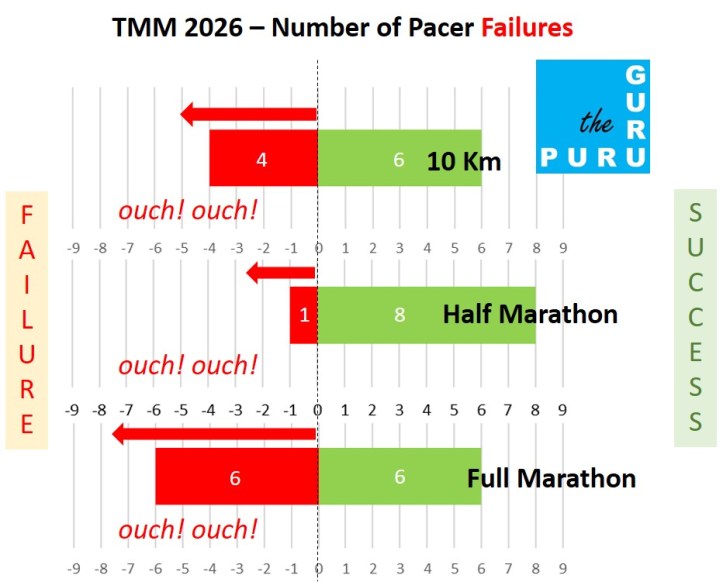
The graph above shows the number of pacing failures in each race event. Ideally, we should have seen only green and no red. Ouch, ouch! So, the graphic gives us a clear message – the results are not great.
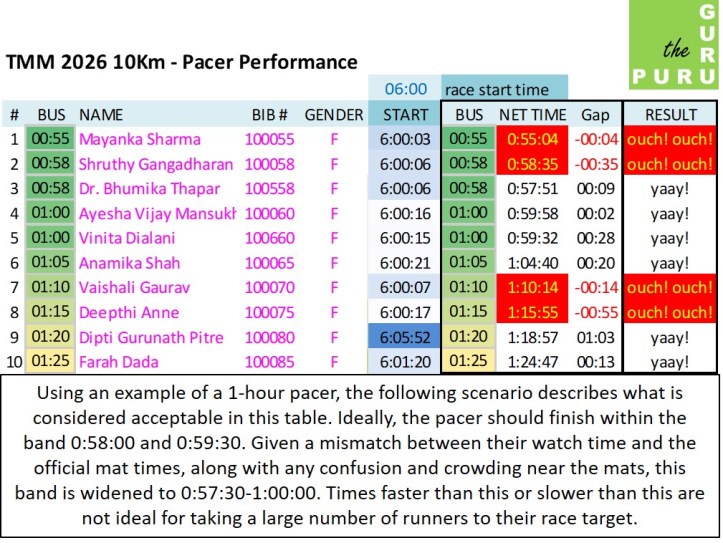
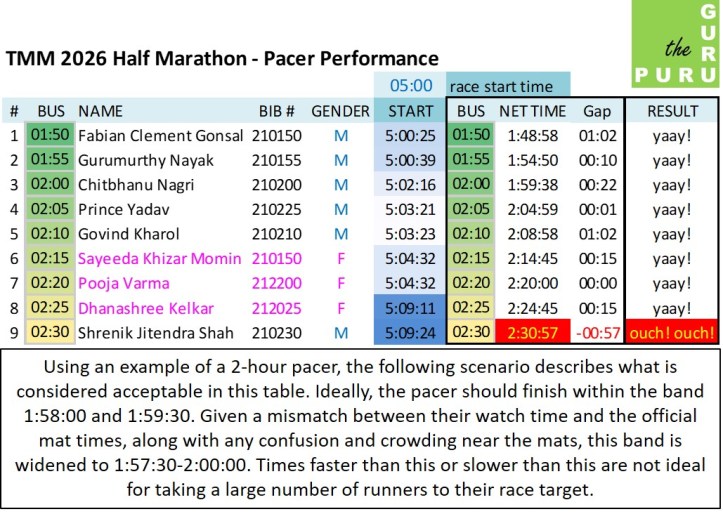
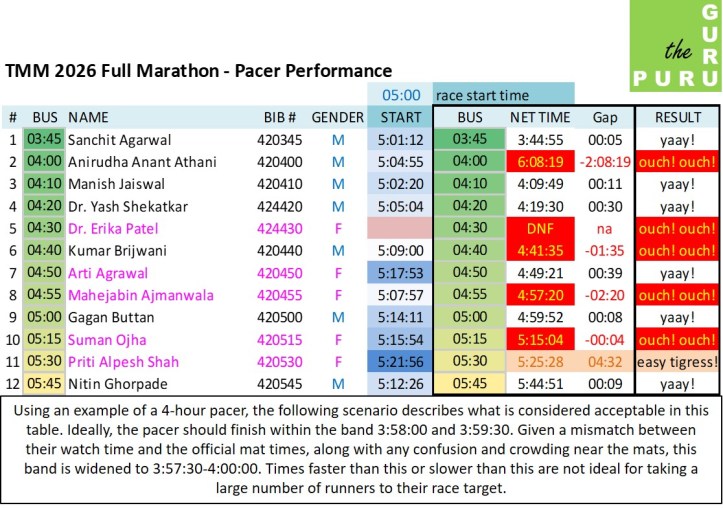
I present in tables the results for each pacer for the 3 events. I will try to comment a little based on what we can observe.
10 Km [top]
Half Marathon [top]
Full Marathon [top]
Tight Finishes and Tigers [top]
Any pacer with a “Gap” of less than 30 seconds should be careful to finish a little bit faster next time. Although they received a yaay! there is a distinct possibility that a participant who started off a few metres ahead of them in the crowd and finished a few metres behind them will have missed the target by a few seconds.
Finishing almost 5 minutes earlier than the target time (“easy tiger/tigress!”) is also poor pacing because it reduces the number of successful participants that day whose maximum abilities were close to the target time.
Puru Wearing his Economist Hat [top]
A positive outcome of India’s vast and ambitious population is that businesses are aggressively competing for every price segment of any product or service. Even in an expensive city like Mumbai, you can get a hot, freshly cooked, spicy meal to satisfy your large appetite and pass Puru’s “quality of nutrition” tests for as little as Rs 60 (US$0.65).
A problem often witnessed with a monopoly in operation is high pricing and poor quality of service. Sometimes this monopoly emerges naturally and cannot be easily broken. A break can occur when a massive event, such as a pandemic, emerges. Or, a technology like AI emerges. Or a regulator steps in.
With the flagship marathon event of India, the Mumbai Marathon, held on the third Sunday of January each year, being a private event, no regulator dares step in beyond ensuring basic public safety. On the one hand, it is commendable that the race organisers manage an event across a large geographical space in the most densely populated city in the country. On the other hand, with no competition and no profit motive for perfect execution of pacing for runners, the result for that service is that of a badly run monopoly.
An analogy that many will appreciate is as follows. An employer provides a free cafeteria lunch. Sounds great? But what if the meals they serve leave most employees dissatisfied? Initial excitement changes to disappointment, followed by disdain and even mistrust. Soon enough, the employees take care of their meals themselves. The employer will continue to showcase the free meal service to the outside world, which has become inexpensive to provide with fewer takers in the workforce. The insiders know they need to fend for themselves. And, as often happens, employees may fear speaking out against the deception and injustice. There is no free lunch!
Crowding in your Market [top]
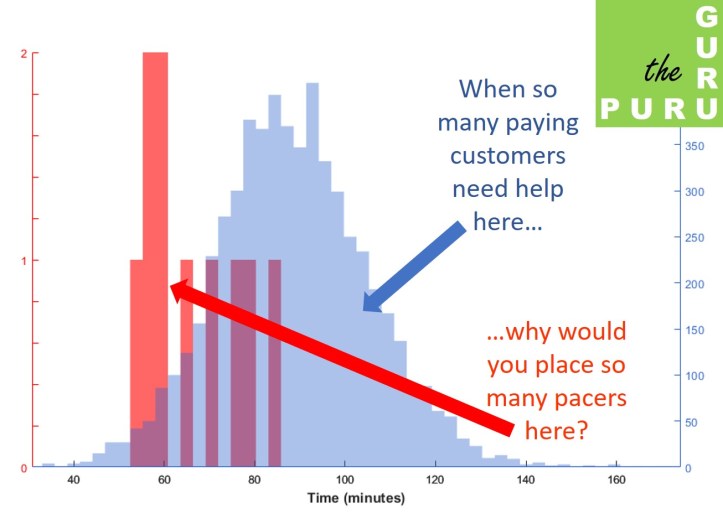
With self-regulation, you can have a problem in any industry. Check out how so many 10 Km racers were left without a pacer option, whereas a tiny minority of more capable customers were relatively over-supplied with pacers.
Towards Greater Female Empowerment [top]
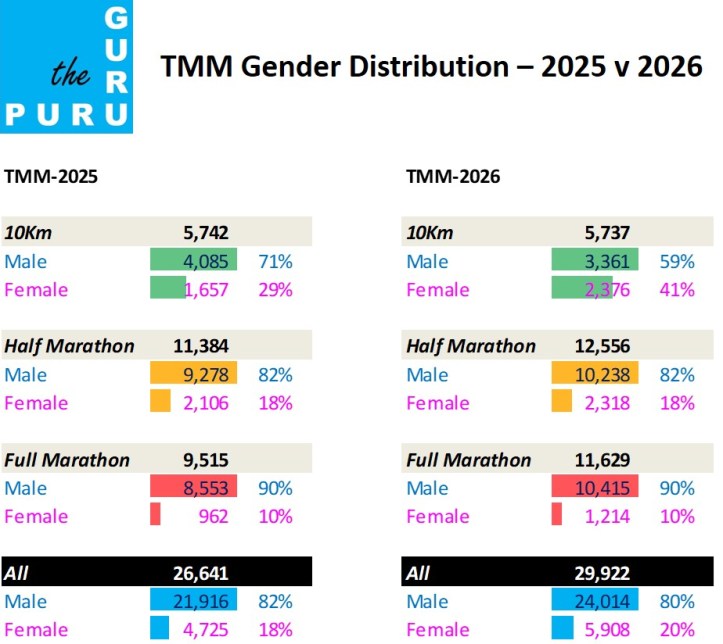
The Desi Dude should continue to encourage and support the females around him to follow their passions. If running event participation is a marker of improving public health, it would be good to see more females participating. What is good to see is that there were more female pacers this year than male pacers. The ratio of males to females amongst the pacers was 13-to-18 this year. Last year, that ratio was 16-to-15. And, in the previous year, that ratio was 28-to-17.
I won’t discuss the various ways that all of us can empower more women to take advantage of recreational distance running for better health. Instead, I present the gender-wise split of participants in the 3 races for this year (2026) and last year (2025). It is only FYI – we cannot draw any firm conclusions about something that is multifactorial. What I will say is that you do not have to run very long distances to be fitter. And, I can also say that you do not need to run (to be fit).
Previous Years’ Results [top]
Mumbai Marathon Pacing Failures:
2025 Report
2024 Report
2023 Report
2020 Report
2019 Report
2018 Report
2017 Report
2016 Report
2015 Report
Take-Home Message [top]
Pacing at the Tata Mumbai Marathon 2026 was once again disappointing and far below what is desired, with significant failures across the 10 km, half-marathon, and full-marathon events. Despite years of data and feedback, the flagship Indian marathon continues to deliver poor value for its high-profile responsibility, largely because it operates like an unchallenged monopoly—with no strong competition, regulation, or incentive to achieve near-perfect pacing execution. This leaves many runners underserved, similar to a disappointing “free cafeteria lunch” that people eventually learn to avoid or distrust.
Parting Message [top]
I am only the messenger. Do not shoot me for making the effort to collect all the information and present it in an easily digestible format.
It is your smallest of habits that define who you are today and who you will be tomorrow. If everything you do is consistent with your core beliefs and desires, then a long and healthy life of joy is pretty much guaranteed to be yours. If you would like detailed guidance, you know how to reach me. If you found this useful, please do share it with others.
Puru

Dr Purnendu Nath spends his waking hours focusing on helping individuals and organizations reach their goals, to make the world a better place. He speaks, writes and advises on topics such as finance, investment management, discipline, education, self-improvement, exercise, nutrition, health and fitness, leadership and parenting.
 Puru The Guru
The 4 hour pacer got an ankle twist in the first 2kms only. It can happen to anyone. So, please read a bit about such cases and also include them in your article.
LikeLike
Thanks for pointing that out, Sumit. I am not particularly interested in why one particular pacer did not perform as promised. Every failure has a story, whether it is accidental/luck or by (poor) effort. I have been running on all kinds of surfaces for almost 20 years now and never twisted my ankle to a point of not keeping the pace I am required to.
LikeLike