
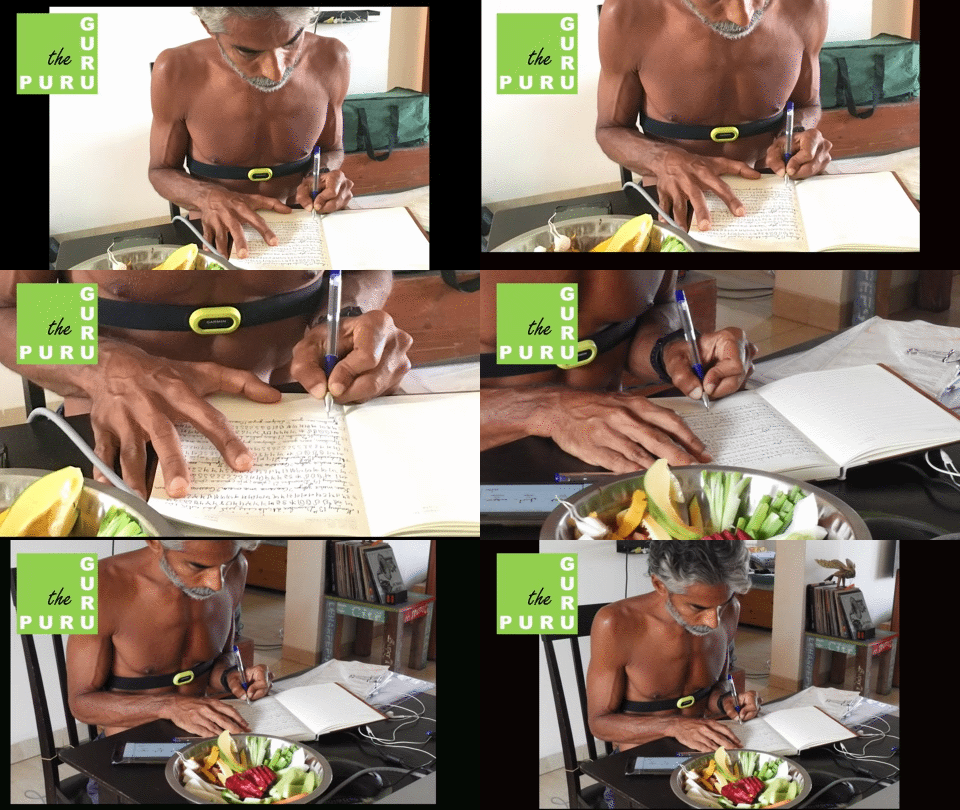
If I am always so busy working on things I enjoy, such that I will think hard before I take up an offer to do something for additional money, why do I make time every single day to do some Left Hand Writing? What can you learn from understanding why I started it, then continued it beyond the honeymoon period and why I plan to do it every day forever? If you genuinely want to work towards an amazing future for yourself, you will gather some gems by the end of this conversation.
If you find it useful, please share this with your family and friends. All the other 170+ articles are here.
If you would like detailed guidance to discreetly upgrade your life – health and wealth – visit the mentoring page or the coaching conversation page.
(NEW!) For some testimonials from around the world, go here.
Contents
What is Left Hand Writing?
My Motivation for Telling you About it
How Simple or Complex is LHW?
Why did I Start LHW?
Why did I Continue after the Honeymoon?
Why will I Continue until Death?
Other Activities for the Left Hand
How might You Invest?
Take-Home Message
Parting Message
What is Left Hand Writing? [top]
There’s no mystery, Left Hand Writing or LHW is just that – writing with the left hand.
My Motivation for Telling you About it [top]
You are likely to have your equivalent of what I call LHW. It might be something that piqued your curiosity that you have often thought about doing but have not started yet. Or it might be something that you have been doing for a while, and now you wonder why you do it and where things might go.
My motivation for talking to you about why I do LHW is only to inspire you in some small or big way. Whether you have yet to start a similar journey or are looking to stay on a path that you believe enriches your life, I believe that what I have to say will be helpful.
As with anything, God (or the money) is in the details. Keep reading to see how you might invest.
How Simple or Complex is LHW? [top]
When you step back and look at it, LHW appears simple enough, because we can say the 3 words so easily – left, hand, and writing. When we zoom in, we can see complexity in the details of quality execution.
Writing is a skill that you learned over many months as a child. How you hold the pencil or pen kept changing initially, and then settled into how you write today. Today, you don’t think much about the physical dimension when you write. Beyond gripping the pen and pencil, how you grip the page you’re writing on, how you angle yourself relative to the page, the height at which you place your shoulder relative to the page, they also matter – things you don’t think about today when writing with your dominant hand.
As far as fine motor skills go, writing is as complex as surgery (which is less tolerant of small errors) and needlework (which is a non-compulsory life skill). Writing has great utility, especially when creative thinking is required, which a keyboard cannot replicate. Writing can help you simplify by unpacking what seemed, at first, like a complicated idea, or for you to neatly arrange a set of confusing thoughts swimming around in your brain.
You settled into writing with your dominant hand almost immediately after you started to learn how to write. To be efficient with time, you were not encouraged to write with either hand. In your days as an infant, you might have had some freedom to choose which hand to do things with, but by the time you started learning to write, everyone knew your dominant hand. Getting the job done faster and with fewer errors leads to the policy of specialising in writing with the dominant hand. This practical logic underpins writing and the other tasks you do with your dominant hand.
Learning to “do it with the other hand” will require that you invest between a few hours and many weeks, depending on the activity or skill. During one of my trips to Hong Kong to stay with my Chinese family, I trained myself to eat using chopsticks with my left hand instead of my right. Although using chopsticks requires skill, and using the non-dominant hand needs a bit more focus, the complexity of writing means that LHW for a right-handed person takes far longer to get to a decent level of proficiency than using chopsticks with the left hand.
When and Why did I Start LHW? [top]
I was stuck in Dubai for 100 days during the COVID-19 restrictions. Like you, I enjoyed many aspects of that period and its positive effects on my life. I was in daily communication with a friend and scientific co-author, a surgeon living in Mumbai, and our conversations then revolved around the papers on COVID that we were writing together to publish. Then, suddenly one day, she said, “Guess what, I tried writing with my left hand today – it was interesting.” I responded, “Hey, then, let’s start that as daily personal hobbies!” and that is what kicked it off.
I had always been curious about ambidexterity, and a few years before COVID, my daughter had told me about the term “neurobics” – a term coined to describe “workouts for the brain.” So, on 24th May 2020, Eid-ul-Fitr, a day after the month of Ramadhaan ended, I embarked on an uncharted journey of LHW. That was exactly 5 years and 1 month ago, and during the 1,858 days since then, there have been only 3 days when I have not done some LHW. Yes, I am definitely a Consistency Conqueror!

When I started it in the middle of COVID, part of the motivation was to be able to explore something new without needing to leave the house. Embracing being physically constrained like Nelson Mandela or Malcolm X did has always been inspirational for me. I began learning to write with my left hand out of curiosity and a desire to once again experience neuroplasticity firsthand, challenging my brain in new ways. It struck me as something both cool and practical—offering potential benefits in ambidexterity and daily utility—while also serving as a personal demonstration of my trust in the science that explains how our brains and bodies adapt through effort and intention.
Why did I Continue after the Honeymoon Period? [top]
I cannot deny that I am generally addicted to positive self-transformation. So, observing daily progress in becoming more ambidextrous for writing was fascinating. While some may see every aspect of their lives through separate, narrow lenses, others try to see the network of connections across them all. I could see how, within the context of the SAID principle, the LHW was positively influencing all the other things that I was now trying to do with my non-dominant left hand. My friend, caught left-handed in this crime too, shared her notes with me regularly on her experiences – our conversations were now going beyond “COVID this and COVID that” to matters that we did have so much more control over. She lives in Canada now, and I asked her about LHW recently – she said she still does it “on and off”.
Why will I Continue doing it Until Death? [top]
It is my birthday today, and I did some LHW today as well – it is one of my daily non-negotiables, like doing mathematics, or eating green leaves. I’ll continue writing with my left hand because I can see daily progress with no clear ceiling—each stroke is part of an Internal Culture of consistency and growth. It’s no longer just an exercise, but a facet of my polyglot journey, integrating seamlessly with other left-handed tasks and reinforcing the mindset that skill, like language, thrives through use. This practice sharpens my awareness of the body’s natural asymmetries while keeping alive the cognitive muscle that resists decay through deliberate challenge. Mindfulness during any bout of LHW is high, and that translates into greater mindfulness with other activities.
Other Activities I use the Non-Dominant Hand for [top]
To the extent that parts of the brain and neuromuscular pathways overlap, each activity performed with the non-dominant hand can influence the performance of another task also carried out with the non-dominant hand. Sometimes, the overlap will be negligible, e.g. stirring coffee in a cup relative to throwing a tennis ball. Sometimes, the overlap will be significant, e.g. playing badminton relative to playing table tennis.
Here are a few of the many other activities that I use the non-dominant hand for:
Badminton – always start with the left arm for warm-up drills
Table Tennis – always start with the left arm and switch to the right if required to avoid losing a game
Kitchen – cutting, chopping, or slicing vegetables and fruit
Scissors – when cutting open sachets or packaging in the kitchen
Coffee – stirring is not as instantaneously easy as you might imagine
Chopsticks for eating rice or noodles from a bowl
How might You Invest? [top]
Your first goal should be to identify your equivalent of LHW. It could be something like meditation, a daily prayer, starting every meal with a salad or even LHW.
One of the best ways to fail to reach an ambitious outcome goal is to start with an ambitious process goal for your first day or your initial weeks. The best process goal to start with should be to show up every day for a short while and do the bare minimum or a tiny bit more. Fake it till you make it!
When you decide that you are going to be a Consistency Conqueror, you will have implicitly decided to succeed. Between deciding to succeed and achieving success exists a gap – the invisible Implementation Gap. You must close that Implementation Gap, perhaps even with some assistance from AI. Remember, however, that AI cannot close the entire gap without your involvement. If you want to eliminate uncertainty and guarantee closing the Implementation Gap, you can always engage with me.
Take-Home Message [top]
A practice of daily Left Hand Writing, or LHW, is simple yet transformative, fostering neuroplasticity, ambidexterity, and mindfulness through consistent effort. By starting small, embracing curiosity, and committing to lifelong growth, you can identify and sustain your own “LHW equivalent”—a personal habit that drives your Internal Culture of positive self-transformation and helps close the gap between intention and success.
Parting Message [top]
It is your smallest of habits that define who you are today and who you will be tomorrow. If everything you do is consistent with your core beliefs and desires, then a long and healthy life of joy is pretty much guaranteed to be yours. If you want to be guided in detail, you know how to reach me, and if you found this useful, please do share it with others.
Puru

Dr Purnendu Nath spends his waking hours focusing on helping individuals and organizations reach their goals, to make the world a better place. He speaks, writes and advises on topics such as finance, investment management, discipline, education, self-improvement, exercise, nutrition, health and fitness, leadership and parenting.
 Puru The Guru
[…] of my hobbies—like LHW or mathematics—shape only my internal space. Others, such as language learning or researching and […]
LikeLike