
🎧 Prefer audio? You will love listening to this AI-made version of the article:
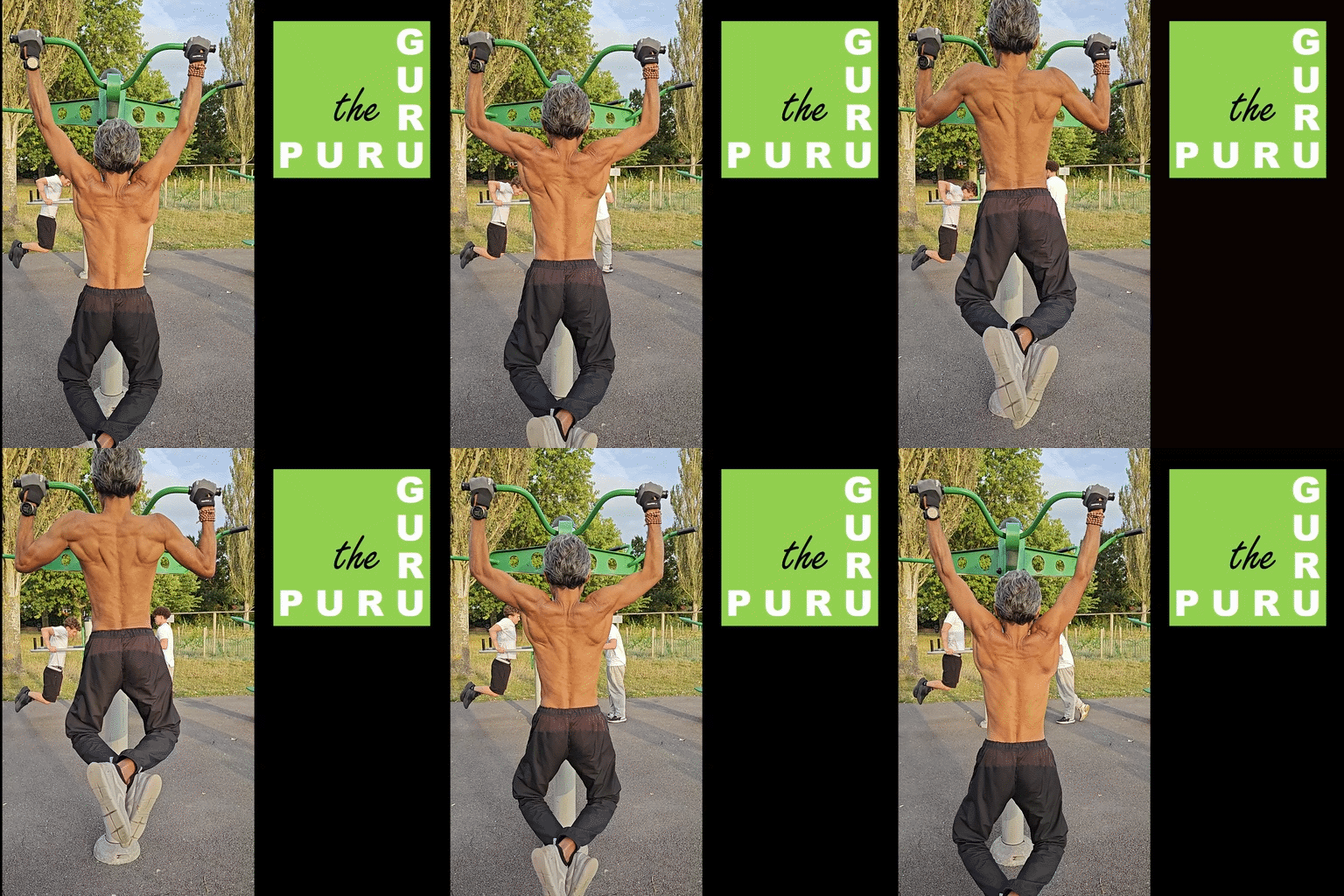
I am going to unpack “Fasting & Muscle Loss” today so that in a few minutes you can go away knowing how best to handle two of the most powerful and high ROTI tools for improving your health and fitness levels in the short, medium, and long-term.
Recently, well-meaning but uninvited, unscientific, and wrong advice, “You should not fast for so many days, you will lose muscle” prompted me to write again today, after a gap of over 5 years, on the topic of fasting. I have been disciplined with fasting for over 30 years. Over the last 10 years, I have become an expert in protocols through research combined with teaching others both the science and practical implementation of fasting for improving health and fitness. So, it troubled me when I recently came across random strangers on social media sanctimoniously advising me with “bro science” statements. For example, “If you fast, your body will eat up your muscles for fuel” is exactly what the sickcare industry and Big Food want you to believe so that you do not use fasting to increase your Healthspan.
Read through from start to finish, but if you spot a segment listed in the Contents of specific interest, simply jump to it.
If you find it useful, please share this with your family and friends. All the other 160+ articles are here.
If you would like detailed guidance to discreetly upgrade your life – health and wealth – visit the mentoring page or the coaching conversation page.
(NEW!) For some testimonials from around the world, go here.
Contents
The Importance of Fasting for Healthspan
Fasting – Prior History and Articles
Muscular Performance – Prior History and Articles
The Term Structure of Fasting Fear
1234Up to 24 hours
1234Up to 72 hours (3 days)
1234Up to 120 hours (5 days)
1234Beyond 5 days – the atthai and longer durations
Why the Fear and Fear-Mongering?
1234Visual Changes
1234Incorrect Attribution
1234Fear of (Muscle) Loss – Strong Humans
1234Fear of (Muscle) Loss – Weak Humans
1234Hunger Pangs
Micro Changes from Prolonged Fasting
Macro Changes from Prolonged Fasting
1234Total Body Mass
1234Body Composition
12341234Fasting Phase
12341234Refeeding Phase
Why Muscle Loss is a Lie
1234Hand-Waving (Bio) Logical Arguments
1234Anecdotal Evidence and Case Studies
1234Scientific Studies Involving Humans
1234The Strong Elephant in the Room
1234Do NOT Ignore the Other Muscles
1234Muscular Strength, Endurance and B.S. C.R.A.P.
Stronger and Leaner Elephant with 2 Big ROTIs
Nutrient Depletion
1234Macronutrients – Depletion and Replenishment
1234Micronutrients – Depletion and Replenishment
Tracking
Parting Message
The Importance of Muscle for Healthspan [top]
The single word that can summarize the purpose of muscles is movement.
Movement of all kinds within your body happens because of involuntary muscles. The fuel through food and drink required to power your limbs is processed in various stages thanks to the automatic muscular action of moving what you eat and drink by swallowing, moving it through your digestive system and pushing it out at the far end. Your blood that takes various nutrients including the fuel from your digestive system around your body is pumped through your circulatory system by the muscles of your heart. All that beautiful flow happens without you consciously doing much.
The voluntary muscular action that you are more conscious of is everyday physical movement. It could be small easy movements like using your fingers to scroll down this article. It might be strenuous movements like pushing or pulling weights after you are reminded about the importance of muscle growth and maintenance today.
Those who build and maintain muscle can expect to experience significantly better life quality in their later decades than those who do not. Besides making it easier to conduct activities of daily living like carrying groceries or moving house furniture around while cleaning the floor, it also helps with creating greater cognitive reserve to fight many forms of cognitive decline e.g. Alzheimer’s disease in old age.
The Importance of Fasting for Healthspan [top]
Humans, like thousands of other animal species, have evolved over hundreds of thousands of years to thrive without food for durations ranging from many hours to many days. The most recent 12,000 years of agrarian living has meant that food has been available to those who do not wish to go without it for more than a few hours. Unfortunately, modern lifestyles have meant that today many humans do not even manage 12 hours regularly for an overnight fast. This has led to a whole host of health problems. The simple proof of this is the evidence of subsequent improvements in health markers observed in carefully controlled studies in which such diseased adults are fed the same quantity of food but over a shorter time window for feeding i.e. a longer fasting window.
It is beautifully logical that if you reverse an unnatural way of being and go back to doing what humans have naturally evolved to do, you are going to reverse a whole host of modern health problems. This has now been proven to be true through numerous studies that show that fasting as therapy is powerful for reversing many diseases.
Fasting – Prior History and Articles [top]
The first article I published around fasting over 10 years ago was to outline the simple reasons for Ramadhaan fasting that I have been doing now for the last 33 Islamic calendar years – no food or drink during sunlight hours for 30 days in a row.
Then I wrote about Ramadhaan Running for all Faiths to explore the topic of running even in hot humid weather while fasting without food and water, something that I have continued to do every Ramadhaan.
Around that time, when fasting became popular in fad-obsessed cities in the West and then flowed back to the East, I stepped up and wrote about Time Optimized Feeding, a more positive way to describe and manage your fasting and feeding windows. Around then, about 9 years ago, I started to capture data about my feeding and fasting windows.
After fasting daily for 2 years in addition to the annual Ramadhaan dry fasting, I wrote this to describe my experience over those 2 years, for which I had collected vast amounts of personal data.
I then wrote about being an Ekahari and the Birth of the Brunchnner – Ekahari is an Indian language term now popularly known in the West as OMAD – One Meal a Day. This was soon followed by The Ekahari Log Blog about my experience with one meal a day for 2 years.
I then explored the practice of prolonged fasting and wrote a Guide to Multi-Day Fasting – and soon, thereafter, published MDF5 – The Log Blog – describing my experience during my first 5-day water-only fast.
There has been a 5-year long gap between that article and today, primarily because I assumed that there was sufficient knowledge now across the internet on the benefits of shorter and prolonged fasts.
Earlier this month, I completed my 7th water-only annual fast during Paryushan, a period of penance, prayer and reflection observed by followers of a tiny religion with its roots in ancient India called Jainism. It is called an atthai because of the 8 continuous days without any food (and water only during daylight hours). The “atth” (eight) ends up being closer to 9 days because of the rule “no food or drink between sunset and sunrise” a common practice among the stricter adherents of the Jain religion for all days of the year. Doing the atthai is extremely difficult, which explains why less than 1% of the Jain population seems to do it.
Many Jains will follow a less demanding pattern of fasting during Paryushan. For instance, some may do the OMAD for 9 days. Others may alternate between 48-hour fasts and the OMAD during those days of Paryushan. At the extreme end, a lady I mentor once did a maas khaman – no food for 30 days, along with no water at all for the first week – something that even I cannot imagine myself doing because of its difficulty! She is extremely brave!
Muscular Performance – Prior History and Articles [top]
I have been regular with Strength Training now for just over 16 years. For about 15 years prior to that, I did not do much for building or maintaining muscle. My pathetic excuse was that I was busy building my CV and external wealth portfolio. When I started mentoring others professionally 11 years ago, to guide them to lead better lives, I trained and passed examinations to be certified by the American College of Sports Medicine. This training empowered me with formal frameworks for empowering others and assessing protocols for improving both health-based measures of fitness and skills-based measures of fitness.
My first article around muscle performance 8 years ago was cheekily titled “Pushups for the Ladies” but directed at men too. A few months later I explained how any man, and some women, can build up systematically to doing the 1-arm Pushup. Even though I am living proof of it, so many years after writing about it, people will often not believe that you can get a 6-pack without ‘ab workouts’. In the middle of the COVID-19 pandemic I wrote about Technique, Form & Progression and soon after that about dealing with the emotional battle to be easily won for those who get bored of the treadmill or gym. More recently, related to body sculpting, I wrote about the SAID Principle. All this mastery over muscular performance with low body fat can be done with minimum time invested – 6-Pack or Bikini Body with Large ROTIs.
The Term Structure of Fasting Fear [top]
Up to 24 hours [top]
It has become clear to a large section of the public that they were misled for about 3 decades by the evil mantra that “you have to keep eating many small meals and snacks throughout the day to keep your metabolism high and avoid gaining weight.” Fortunately, today, anyone with an interest in good health makes some attempt at maintaining a long enough overnight fast for as many days of the year as they can manage. Whereas earlier there might have been some paranoia around missing a meal, now, the first time that someone does a 24-hour fast, they congratulate themselves and celebrate, and justifiably so. It is not easy to fast (congratulations!) and doing so improves health (celebration!).
Up to 72 hours (3 days) [top]
Having crossed 24 hours, many who practice the protocol of fasting are unknowingly brave to go up to 72 hours. I say unknowingly brave because for any prolonged fast (e.g. even a no-food-for-30-days water-only fast) the first 48-to-72 hours ends up being the most difficult period to deal with.
Fortunately, today, not many ill-informed critics complain about this duration of fasting destroying your body.
For an overweight or obese person, this could be done twice a month. For a lean person who is keen to do it, once a month ought to be sufficient.
Up to 120 hours (5 days) [top]
This is the sweetest duration. Why? Because having done the most difficult segment of a prolonged fast (i.e. the first 48-72 hours) it is wise to continue to 5 days as the maximum stimulation for your body’s systems to reset and rejuvenate happens at some point between day 4 and day 5. (For rats it happens by day 3.)
An obese person could do this once a quarter. An overweight person once every 4 months. A lean person should be fine to do it twice a year if they wish but at least once a year would be my recommendation.
What this means is that if someone gets over their fear of a 24-hour fast, and then makes it past a 72-hour fast, there should be almost zero fear of a 5-day fast. In fact, an MDF5 is the perfectly sweet duration in terms of the trade-off between the pain and the gain. Day 4 and Day 5 feel almost effortless.
Beyond 5 days – the atthai and longer durations [top]
For those who would like to push themselves for even greater benefits, doing an atthai once a year (by lean or overweight individuals) would be great. You could do it on any date, but even if you are not a Jain, if you feel the comradery would help you get through 8.75 days without food, and only water, then do it during Paryushan when the Jains do it. Whether you live in Antwerp, Adelaide, or Ahmedabad, you will find a Jain community to support you if you wish.
Depending on your precise health status, various activities during that prolonged period of multi-system hormetic stress should be tweaked to support the prolonged fast.
Judging by the extremely low compliance even amongst the Jains who consider themselves to be ardently religious, it is fair to say that the fear of such prolonged fasts is very real. On the other hand, having mentored many non-Jains through prolonged fasts I also know that, with fear just being in our heads, the appropriate physical, mental, and emotional preparation to cruise through a prolonged fast is practically achievable. The spiritual benefits experienced during a prolonged fast are not appropriately described in written or spoken human language but everyone senses growth specifically in the spiritual realm.
Why the Fear and Fear-Mongering? [top]
I now propose some reasons for the misplaced fear of prolonged fasting creating muscle loss. It is an addition and multiplication of many such reasons that irrationally magnifies the misplaced fear.
Visual Changes [top]
Humans like other creatures are visual, and we make many of our subconscious and conscious decisions based on visual cues.
Even a 5-day water-only fast will not produce a noticeable visual drop in body fat as the typical loss is barely over 1kg for a typical adult, and most of that fast loss is the dangerous abdominal (visceral) fat loss, not subcutaneous fat loss. If your total body fat is relatively high, people might not notice much of a relative difference. If you are extremely lean like I am, and especially if a large fraction of your body is exposed to the public eye, the fraction of fat loss that is subcutaneous vis-à-vis visceral is higher and noticeable as both the visceral fat and subcutaneous fat were very low to begin with. For a longer duration e.g. the atthai the visual change is even more noticeable. The visual shock stems from fat loss but is wrongly attributed to (also) muscle loss.
Incorrect Attribution [top]
As part of my service to others as a mentor, I teach individuals how to gain muscle while losing fat, something that is difficult to do for those who have been mis-sold the notion that you need to eat a lot of animal products to gain muscle and strength. When you see the average “big guy who goes to the gym” you see a strong man with a bulky body but not a particularly low body fat percentage, and often with worrying blood numbers. He experiences a gain in muscle mass, visual size, and strength, without losing a large fraction of his body fat. The average person is used to seeing such transformations in their family and friend circles. They equate that visual bulk-up to muscle gain without paying much attention to the limited fat depletion. They implicitly wrongly attribute all the increase in size to an increase in total quality. The truth is that holding on to body fat during the process of increasing muscle mass is neither necessary nor healthy – you just need to learn and implement the right action steps.
The converse of that phenomenon is the incorrect belief that every time someone “has now become thin,” they have lost muscle. The reduction in BMI with a visual drop in bulkiness is incorrectly attributed to coming from a drop in muscle mass, muscle size, and muscular strength. It is even incorrect to conclude that muscle loss is concomitant with a drop in body fat. It is this phenomenon of believing in false reasons that drives bro science comments on social media from strangers when they see a post from me about prolonged fasting.
Put simply, if you lose a lot of fat with NO change in muscle, the average person will likely comment that you have lost muscle. At a practical level, the best advice is to ignore them, roll your eyes and move on.
Fear of (Muscle) Loss – Strong Humans [top]
Amongst humans, the fear of loss has always been given greater weight than the expected pleasure from gain or profit. Behavioural psychologists call this asymmetric response loss aversion and one can understand how it served humans well from an evolutionary perspective. For example, if you do not find a tasty fruit soon to gain pleasure from when you are very hungry, you will still easily survive until you do find one soon enough. However, if you eat a single poisonous berry, it might be your last meal – not a loss you want. You are loss averse because you are more unwilling to experience a potential loss than you are willing to experience a potential gain. This asymmetry in loss aversion is different from the symmetry of risk aversion that many economists assume to describe human behaviour for mathematical convenience.
So, what does “being loss averse” have to do with holding an incorrect belief that prolonged fasting leads to muscle loss?
Those who consciously build and maintain muscle live through the arduous process required for doing so – week after week, often year after year, and sometimes for decades. Having gone through that pain repeatedly for so long and being loss-averse humans, they are hypersensitive to any news, whether true or unscientific and false, in print or social media, regarding muscle loss. Fasting means avoiding something (food) that is important for building body mass – so quick hand-waving logic in the loss-averse brain creates a jump to the conclusion that it must lead to muscle loss. It is the human trait of loss aversion that creates this asymmetrical hypersensitivity. I understand the aspect of human psychology, but the rational response is to follow the real science, not the bro science. But how many of us are extremely rational and logical? If we were, we would not see so many medical doctors with unhealthy lifestyles!
Avoiding food does not lead to muscle loss – failure to stimulate muscle is what leads to muscle loss. Avoiding fuel from food burns fat which is your body’s natural store of fuel. Your body is as intelligent as mine is. So, your body will not store fat for fuel as it logically should, and muscle for movement as it logically should, and then illogically destroy muscle tissue that is difficult to build and maintain and that is essential for you to move around so that you can search for food! It will logically utilize your body fat for fuel!
Fear of (Muscle) Loss – Weak Humans [top]
The fear of muscle loss amuses me the most when it is in people who do not try to build and maintain muscle in the first place. They do not see the glaring absence of strength training as the chief cause of muscle loss and all its related problems at a young and old age. In fact, for such people, a prolonged fast would be superb because they could get rid of dangerous visceral fat and allow their bodies that have limited muscular ability to do a better job of moving them around faster.
Hunger Pangs [top]
No one likes hunger pangs. Nature has hard-coded this within us so that we do not ignore it and ensure that we fulfil the primary purpose of food – fuel to survive so that we can then procreate. As a primitive sensation it was critical for survival, but today it causes havoc as we have seen with increasing obesity burdens and increasing profits for sickcare systems. Reason can fly out of the window of an intelligent person’s brain when hunger hits. The idea of having to face many hunger pangs during a prolonged fast, hunger pangs about which they think they can do nothing, creates great fear in intelligent humans. Instead of seeing the hunger pang as a primitive warning signal that is harmless and non-critical, most people lose their ability to rationalize and see it for what it is in the 21st century – something that can be ignored for our benefit. All you need to do is allow the hunger pang to pass. It happens within minutes if not seconds!
Micro Changes from Prolonged Fasting [top]
The beneficial changes at a micro level from a prolonged fast are numerous but not easy to measure outside a research or lab environment. If you are in a part of the world (e.g. India) where it is convenient and cheap to measure blood markers reliably, I would strongly recommend you do this. To know what to measure before, during and after such an amazingly powerful protocol is important. Then, going through the process of understanding what those numbers mean will be very empowering for you.
Macro Changes from Prolonged Fasting [top]
Let us discuss what we can measure at home that is related to the topic of this article – Fasting and Muscle Loss.
Let us consider body mass (total Kg) and body composition. Body composition is the split of your body mass between fat mass and non-fat i.e. lean mass. Fat mass can be further split between visceral (around organs) fat and subcutaneous (below skin) fat. Lean mass is the remaining mass of your body. So, it includes your muscles, organs (including your largest organ – your skin), bones, water etc and will also include the food that is in transit through your gastrointestinal tract.
Consider the case of someone whose body mass and body composition are steady prior to a prolonged fast and who continues the same dietary pattern after the prolonged fast. I use the words mass and weight as synonyms but school physics will remind you that when you say your weight is 50kg, you are, in fact, referring to your body mass “m” – however, your weight, “mg” or “m multiplied by g” includes “g = 10, approximately” and so your weight is then 500 Newtons (not Kg).
Now, think of 3 phases of a Prolonged Fast:
- the pre-fasting days,
- the prolonged fasting days,
- the days after refeeding
With the pre-fasting phase as a baseline, consider the changes in body mass and body composition that happen during the 2 subsequent phases – fasting phase and refeeding phase.
Total Body Mass [top]
This is a single variable and can be measured extremely reliably with a weighing scale. It will drop continuously during the prolonged fast and will rise once refeeding commences and then settle at a level lower than in the pre-fasting phase. But to what do we attribute these total body mass changes across the fasting phase and the refeeding phase?
Body Composition [top]
With the pre-fasting phase as a baseline, let us consider what happens to your body composition during the fasting phase and the subsequent refeeding phase.
Fasting Phase [top]
During the fasting phase, the reduction in body mass will be from:
- Carbohydrate loss by the end of Day 1 – most people are unaware that even an obese 150kg human who stuffs himself mindlessly with carbohydrates will have a maximum of only 0.6kg of stored carbohydrates (80g of “compact glucose” called glycogen in the liver and about 500g in the muscles)
- Water loss from salt loss through sweating (salt in the body “creates water retention”)
- Water loss from muscles (because each gram of glycogen is stored with at least 3 grams of water)
- Food exiting your body (as poop!!) through the duration of the prolonged fast – yes, even after many days of no eating there will continue to be natural defecation to completely empty out your gastrointestinal tract
- Fat loss – mostly visceral fat from around the organs, and partly subcutaneous fat
Refeeding Phase [top]
Your total body mass will climb back up fast from its lowest point because of:
- Re-fuelling of the carbohydrate stores in your body (back to the 600g for a healthy adult male, stored as that compact form of glucose called glycogen). Remember, glucose is the fuel source for quick response systems (e.g. sprinting, or bending down to lift your suitcase to put into the trunk of your car).
- Water weight gain because of salt naturally found in food and because of salt you add to your food and drink
- Water weight gain when each gram of glycogen is stored in your muscles and elsewhere is along with at least 3 grams of water
- Food that is now in different stages of digestion along the long length of your alimentary canal from your stomach to your colon
- Fat stores in case you eat more than your caloric needs. Remember, once your relatively tiny carbohydrate storage tank (0.6 kg) is full, all excess carbohydrates get converted into fat and are stored in your adipose tissue. The excess fat you eat also gets stored. And, if you eat excess protein because you are paranoid that you lost a lot of muscle, that too gets stored as fat if you do not excrete it in your urine.
It is only the last of these, the fat stores that you have some control over during the refeeding phase. All the other sources of weight gain are harmless or useful. To the extent that you do not overeat beyond topping up your carbohydrate stores after the fast, your body mass will stabilize at a level below your original weight to match the fat burn during the prolonged fast.
Why Muscle Loss is a Lie [top]
You might be thinking, at this stage, “Hold on, why did Puru completely ignore dealing with muscle loss when discussing all the biological changes during a prolonged fast?” No, I was not being sneaky. Read on for explanations from multiple angles with different flavours. The gold standard argument is the body of scientific studies involving humans which I also refer to below.
Hand-Waving (Bio) Logical Arguments [top]
Nature is always a genius in adapting to circumstances on a continuous basis. Your body has evolved with specific parts to do specific things. Your eyes are a specialized part of your brain meant for vision. Your ears are meant for receiving audio signals. Therefore, keeping your eyes shut for 10 days will not make your ears suddenly develop the ability to see! And you cannot feed yourself breakfast through your ears. Nor can you scroll on your phone with your neck rather than your fingers. It will not be your liver that pumps blood around your body if your heart was to suddenly fail, and your kidneys are not what help you maintain balance on a narrow ledge that you need to walk on during a trek.
All this sounds ridiculous, of course! But, therefore, do you see where I am going with this simple bio-logic?
Muscles are designed to contract to facilitate movement. Fat stores are primarily used for fuel. To think muscles would be transformed purely because of not eating for 10 days requires our thinking to be quite perverse, illogical, and wrong.
Anecdotal Evidence and Case Studies [top]
A downside of anecdotal evidence from a single person is that it cannot be reliably translated into general guidance for others. An advantage is that it inspires researchers to ask interesting questions and conduct more extensive research. Where detailed data is collected at an individual level it is no longer anecdotal and can be presented as a case study. However, the results can still not be scaled out to the general population – until the phenomenon is studied across many individuals. On the other hand, for that case study, at that specific individual’s level, the phenomenon being examined can be useful for that specific individual.
With extremely detailed timestamped data that I have been collecting for my own prolonged fasts, I know with a high degree of certainty that there is no change in muscle mass or muscle performance for me between 5 days prior to a prolonged fast and 5 days after a prolonged fast has ended.
I have seen this result repeated with numerous people whom I have mentored – no change in muscular performance. Clearly, this muscle loss that some fear would have led to a drop in muscular function – but it did not!
Scientific Studies Involving Humans [top]
Despite it being easy to study in simple or sophisticated ways, research institutions have not tried very hard to answer, “What happens to muscle mass and muscular function when healthy adults undergo a prolonged fast?” For a modality that costs almost nothing, is non-invasive, provides huge upside potential, has minimal risk especially if medically supervised, the one question that the public seems to be obsessed with to the point of paranoia could have easily been answered thoroughly with scientific studies a long time ago. Fortunately, the clinical research team at Buchinger Wilhelmi have helped shed considerable light on the topic in this paper but only as recently as 2021.
To see how little the question has interested professional researchers, on 26th Sep 2024 a search on PubMed returns:
- only 67 references when I search for “prolonged fasting muscle loss” with none of them addressing that question.
- only 41 references when I search for “prolonged fasting muscle loss human” with none of them addressing that question.
Fortunately, if we search PubMed for “Buchinger fasting” we get some very interesting papers referred to in the 41 results of which the most relevant one is this one.
Do NOT Ignore the Other Muscles [top]
In training to be a better intellectual, a simple protocol that I like to follow is to step back and look at the bigger picture on a regular basis. With over a thousand muscles in your body, one simply needs to ask, “If my muscles will get destroyed with fasting then…”
“…Why is the strongest muscle in my body, my tongue, still working perfectly well?”
“…Why is there no change in the size of my heart muscles? Fasting has not destroyed them – in fact, it has helped my cardiovascular health”
“…How is it that I have no problem with making my usual facial expressions? My face has so many small muscles that are still functioning perfectly well. It is just my cheekbones that look more attractive now with less fat on my face!” 👻
Soon after you commence refeeding, and you consume the healthy food that requires chewing (fruit, salad, nuts, seeds, legumes) you may notice that your jaw struggles after incessant chewing simply because it has not had to do similar work for many days. No prizes for guessing why! Those muscles have lost the ability to perform at their peak. Now, read the next section and the entire picture will become even clearer!
The Strong Elephant in the Room [top]
If you have reached this section, it will be obvious to you now that the elephant in the room is strength training for muscles. Whether you fast or not, the sure way to lose your muscles is to not use them. If you eat 3 meals and 3 snacks daily but do not do any work that requires strong muscles, you will not have any – guaranteed! Whatever muscles you do have will weaken and wither away, and old age will suck – again, guaranteed! If you eat only 3 meals a week (yes, I said week) but you do put your muscles to work in a manner that they are stimulated to adapt, they will grow and get stronger – yes, again, guaranteed! Your old age can be rocking and you could die looking very young at a very old age!
Do you want to avoid hospitals? Yes? Then spend more time in the gym!
Muscular Strength, Endurance and B.S. C.R.A.P. [top]
Moving away from the narrow metric of apparent/visual muscle size, in order to appreciate a complete and true measure of gain or loss we must look at quantified metrics of performance for all measures of fitness related to your muscles – strength, endurance, as well as BS CRAP – balance, speed, coordination, reaction time, agility, and power!
You will see that a few days after the refeeding period commences, there has been no drop in performance, and perhaps even considerable improvement!
Stronger and Leaner Elephant with 2 Big ROTIs [top]
The 2 investments you can make with large ROTIs – Return on Time Invested – are:
- Fasting
- Muscle Development and Maintenance
Prolonged fasting always provides a very big ROTI because your health improves without you having to carve out time from your busy life for fasting. In fact, fasting releases time that might have otherwise been spent preparing for and consuming meals.
Muscle development and maintenance ensures you have better insulin sensitivity, your body’s ability to handle the carbohydrates you consume, a higher BMR (a better fat-burning machine) and a host of other lifelong benefits – as long as you keep the muscular system in a good state.
Combining these 2 investments is easy. Simply have an adjusted schedule for your activities that keeps the activities related to the measures of muscular performance on track during the prolonged fast. During my fasts, short or prolonged, I do not stop any of my activities – they are just appropriately tweaked in terms of time of day, volume, and intensity.
Nutrient Depletion [top]
It is logical that there is nutrient depletion during a prolonged fast. The prolonged fast is conducted for numerous benefits but what about the impact of so many nutrients being depleted to different degrees?
Water is a nutrient that we typically do replenish during a prolonged fast. Consider the impact of the depletion of all other nutrients along 2 axes – nutrient type and depletion levels.
Macronutrients – Depletion and Replenishment [top]
There are only 3 macronutrients – carbohydrates, fat, and protein.
The carbohydrate stores are depleted completely in the first 24 hours during the fast and the first to be replenished (stored as glycogen) during refeeding.
We have already discussed how fat is broken down to provide the glucose (a carbohydrate) and ketones for use by your brain and body once the glycogen stores are depleted. As we all have sufficient body fat, there will always be fuel available, even if it is converted to energy at a rate that is unable to keep up with intense physical activity. You may just need to run much slower instead of sprinting. You may also need to reduce the combination of load, tempo, and volume for a given set of strength training movements during a session at the gym. At a practical level, you will never run out of fat as fuel even during a prolonged fast.
You feel the impact of fuel depletion by experiencing the following:
- slower cardio when you are deep into a prolonged fast
- the need to adjust your strength training sessions because the muscles have been depleted of glycogen
Proteins in your body are recycled throughout your life. Your body can process only 10g of protein from food in an hour and can hold a maximum of about 30g of protein in a buffer prior to processing. That is why if you consume 2 scoops of whey protein you are simply producing expensive pee as most of the second scoop will be excreted out. The recycling of proteins is also why you do not need to keep eating protein for 24 hours of the day. More interesting is the observation that even on the 8th day of a 10-day water-only fast, if you cut yourself while shaving, there are amino acids available to rebuild the appropriate tissue on your face rapidly so that you do not bleed to death and the scar heals magically as beautiful new skin forms – skin too is made up of proteins.
A negative impact of protein depletion is not seen in muscle performance on either side of the prolonged fasting phase. You may notice it in terms of more peripheral symptoms e.g. chapped lips, but even those will disappear after the fast.
Micronutrients – Depletion and Replenishment [top]
There are a countless different micronutrients under the banner of vitamins and minerals and they are all needed in various quantities for different purposes. Your body will have large reserve of some micronutrients in so that you do not notice any negative change in your body’s function during a 10-day water-only fast. For example, even though we are told “Vitamin B is water soluble and excess gets urinated and you need it regularly,” your body, in fact, holds reserves of it for many months. For those that you run out of during a prolonged fast, the impact will be minor and temporary. So, even if you do notice something unusual during your prolonged fast, e.g. slightly blurred vision from day-5, the beauty of it is that you appreciate the importance of good nutrition at other times. Sure enough, after your prolonged fast, the unusual symptoms disappear. The collateral damage is expected, temporary, and worth it for all the upside of the fast.
Tracking [top]
I hope you collect and maintain data related to your life on a regular basis and then use it to analyse what works for you and what does not. When you do start fasting, for whatever duration, I hope you track that closely too. Hopefully, you will be able to confirm that what I have said today is true for you too.
Parting Message [top]
Alas, your body has an almost infinite capacity to hoard fat as a store of fuel. It is the loss of this fat that many look forward to through improved lifestyles – including through fasting. However, fasting, including prolonged fasting has benefits well beyond the boring target of lowering body fat – so even those who are lean should consider it seriously to reverse ageing. While losing unneeded body fat is important, so is gaining and maintaining muscle mass. I hope that I have assured you that a prolonged fast per se will not make break down your muscles for fuel. Do regular strength training, fast and feast. You will enjoy thousands of more amazing meals for many years more if you do.
If everything you do is consistent with your core beliefs and desires, then a long and healthy life of joy is pretty much guaranteed to be yours. If you want to be guided in detail, you know how to reach me, and if you found this useful, please do share it with others.
Puru

Dr Purnendu Nath spends his waking hours focusing on helping individuals and organizations reach their goals, to make the world a better place. He speaks, writes and advises on topics such as finance, investment management, discipline, education, self-improvement, exercise, nutrition, health and fitness, leadership and parenting.
 Puru The Guru
[…] Does fasting cause muscle loss? […]
LikeLike
[…] exercising when fasting is one of the more common errors people make. Instead, all that is needed is a tweaking of the […]
LikeLike
[…] The Ekahari Log Blog Multi-Day Fasting – A Guide [this article] MDF5 – The Log Blog Fasting & Muscle Loss Fasting F++ Fasting for Thin […]
LikeLike
[…] it is simple arithmetic applied to human physiology. [top] A happy asymmetry that I covered in an earlier conversation is that when you fast, you can lose fat but not lose muscle because nature has not designed muscle […]
LikeLike
[…] fades, struggle rises, and you decide who you are in that moment. The same edge appears everywhere: lifting a weight, running a trail, resisting temptation, or refusing to over‑interpret a message. […]
LikeLike
[…] lean mass while the fat comes off. Trust that your training is the primary signal for your body to hold onto muscle, with protein serving as the necessary but secondary support. Gym Bro […]
LikeLike